
Hangzhou International Innovation Institute
HENN’s Hangzhou International Innovation Institute seamlessly integrates cutting-edge aerospace education within a verdant master plan, highlighted by the dynamic Flying Roof that embodies ambition and cultural heritage.
Situated in the Yangtze River Delta, the Hangzhou International Innovation Institute of Beihang University is a new international hub for aeronau-tical education and research. Designed as both an academic campus and a science and techno-logy park, it brings together a diverse community of students, researchers, and commercial companies in one dynamic environment.
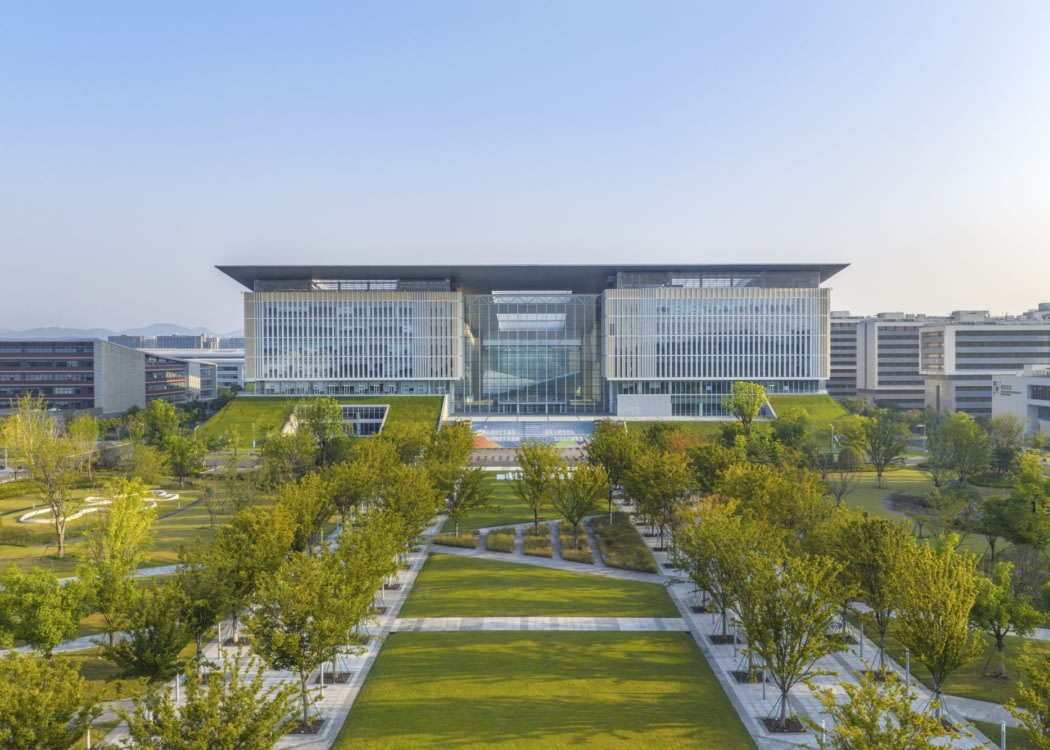
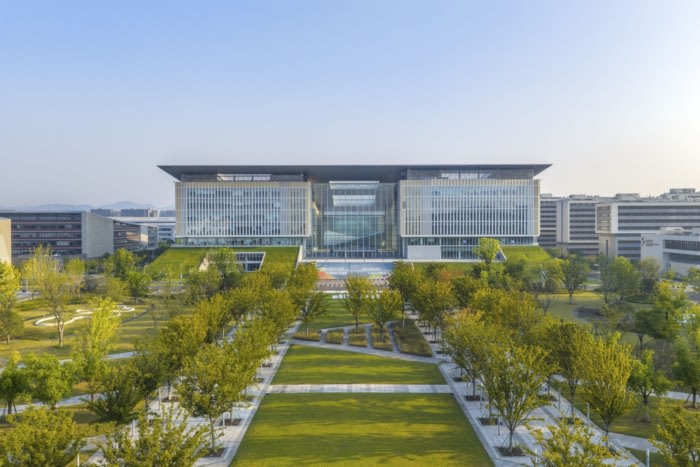
The master plan is defined by two main axes: The north-south academic axis is anchored by a cluster of buildings for academic and social activities sheltered beneath a Flying Roof. The east-west landscape axis connects green spaces and pathways across the site. At the edges of the campus, the cluster is framed by faculty and residential buildings as well as sports facilities.
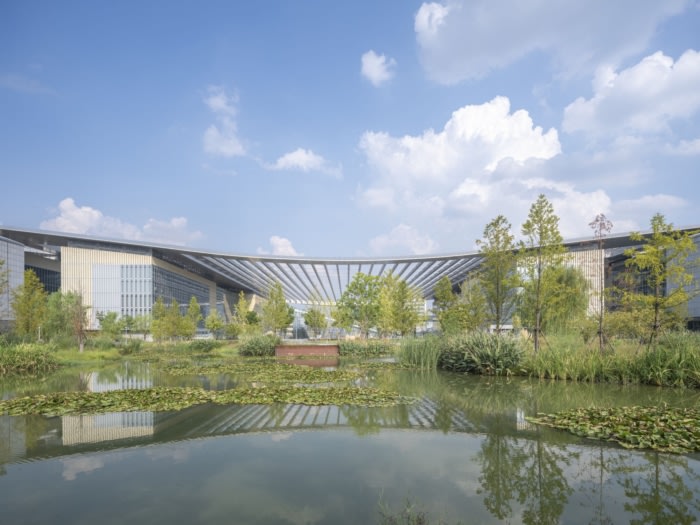
The master plan and architecture were inspired by the neolithic site of Liangzhu, a UNESCO World Heritage site, and the cutting-edge aviation industry. Mineral materials, steel, glass, and concrete blend heritage with contemporary influences. The urban masterplan incorporates regional building traditions, including curved roof silhouettes and a diverse courtyard building structure, which integrates the project into the surrounding water landscape.
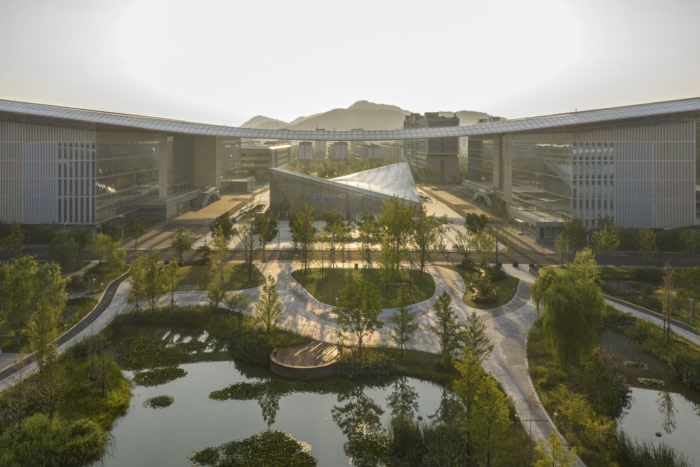
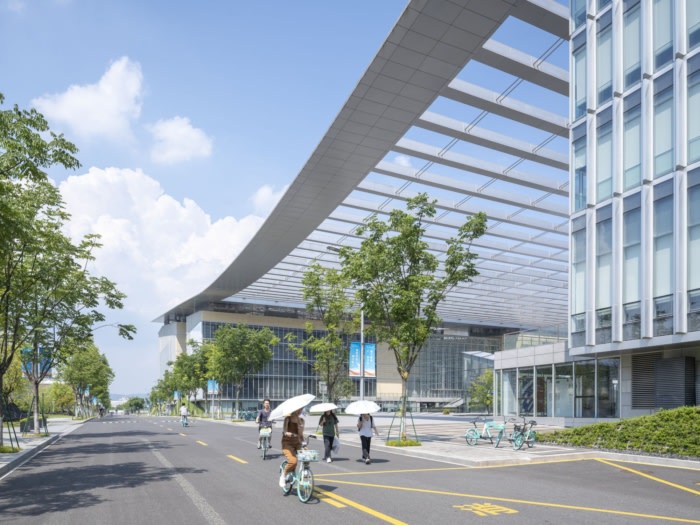
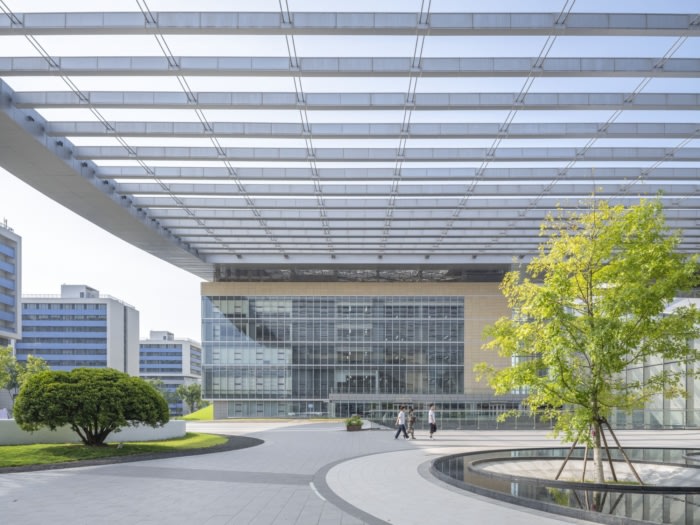
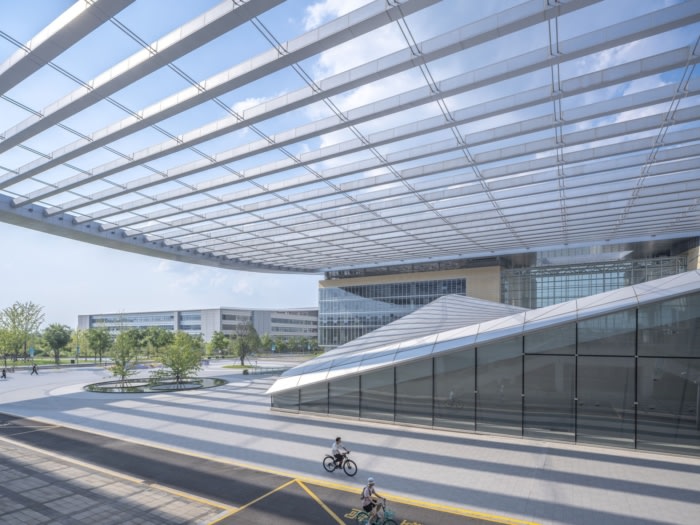
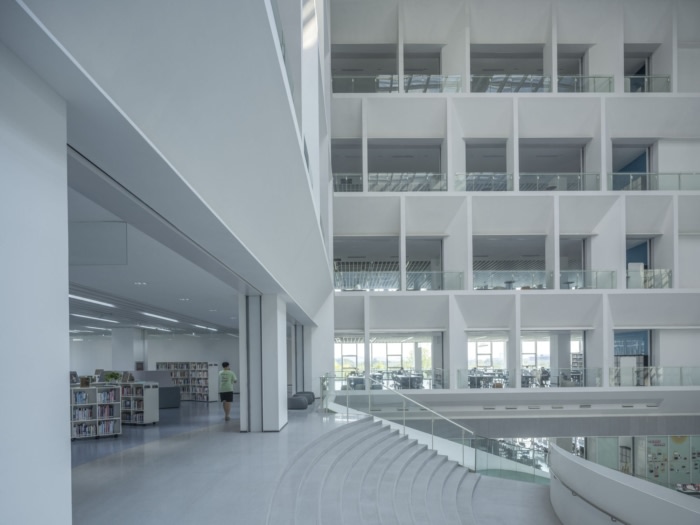
The Flying Roof, one of the largest hanging roofs in the world, is the central design element of the campus and hovers over its social heart. The elegant concave profile evokes the sweep of a plane’s wing or a bird in flight. Its lightweight, tensile structure is inspired by aviation engi-neering and uses minimal material to achieve maximum coverage. With a length of 395 meters and a width of 168 meters, it floats gracefully above administrative office building, library, research labs, classrooms and a concert hall, unifying the separate buildings into a coherent whole. At the intersection of the two main axes, a vibrant plaza becomes a focal point for meeting and exchange, bringing together the academic community.
Classrooms are designed to be highly flexible, making it easy to adapt these spaces for different functions such as office or laboratory use.
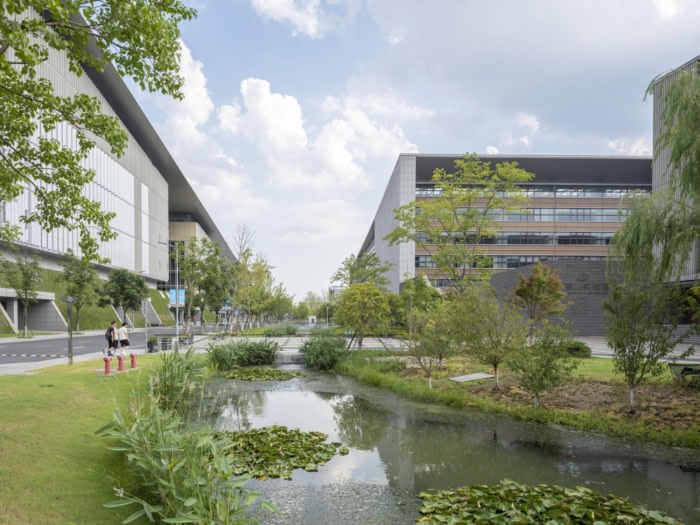
The site is organized in three horizontal layers: the natural topography, a series of low buildings that flow along the site, and a roof grid that floats above. The verdant landscape interwoven into the car-free site is a painterly composition of islands, canals, courtyard buildings, and meandering footpaths that feel less like a campus than a pleasure garden, softening the transition from indoor to outdoor. In the humid, subtropical climate of Southern China, the large courtyards and waterways create temperate microclimates – a site of repose, shelter, and intellectual pursuit.
The design for the Hangzhou International Innovation Institute celebrates the contrasts between the region’s rich history and promising future. Building on more than five thousand years of cultural legacy, the campus invites a new generation of innovation and technological advancement.
Design: HENN
Project Team: Georg Pichler, Hua Qiao, Martin Henn, Leander Adrian, Yun Duan, Fan Feng, Ona Forss, Oliver Franke, Tongtong Gong, Shirin Hadi, Jon Kasa, Rachna Kothari, Xiaojing Lin, Mostafa Seleem, Chen Sun, MingZe Sun, Wei Wei, Tongyu Wu, Lingyue Zeng, Xin Zheng
Contractor: Shanghai Construction Group
Photography: Tian Fangfang





Now editing content for LinkedIn.